Idea in brief
AI capability can move beyond a strategic target before an organization finishes executing its plan. The risk is often an expired assumption rather than a missed milestone. Distinguish commitments that depend on technical difficulty staying high from foundations that gain value as AI accelerates, and allocate capital accordingly.
Every strategic commitment relies on an implicit premise: that the world will hold still long enough for you to execute.
You define a target destination, mobilize your best people, and commit capital behind a major move. It might be an acquisition, an organizational reorg, a market expansion, or an operational overhaul. High-stakes moves demand focus and time.
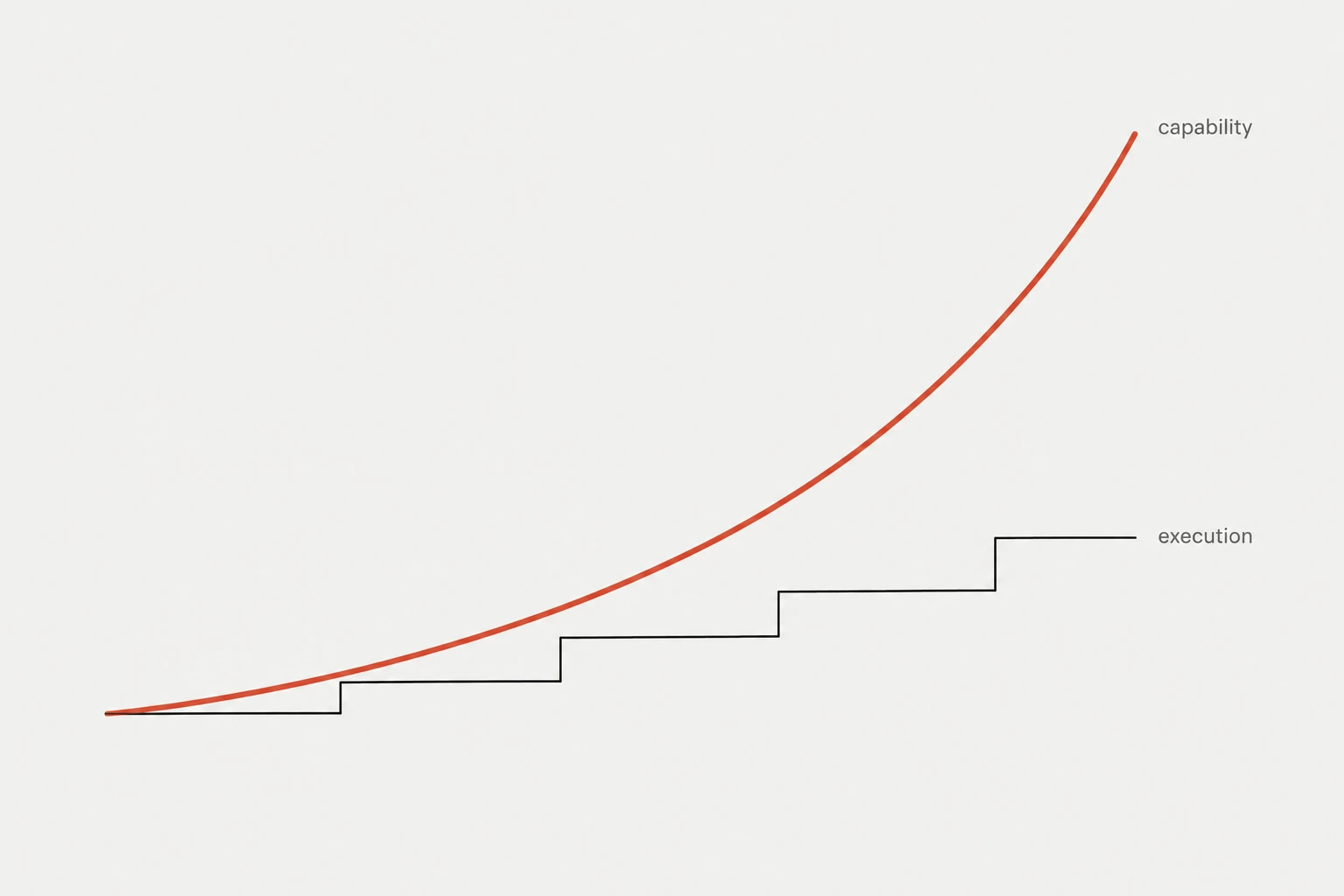
The problem today isn’t that organizations have suddenly become slow. It is that AI continuously advances the capability baseline in the external environment while internal work is underway. When capability shifts every quarter, the implicit premise breaks—and the assumptions underneath a decision can decay faster than the organization can finish the work.
Misreading Disappointing Results
When an AI initiative or technology-driven project fails to deliver its expected impact, leadership naturally looks for familiar causes. The common assumption is that the AI tooling was overhyped, the implementation team stumbled, or the vendor made promises it couldn’t keep.
While poor execution and exaggerated vendor claims certainly happen, there is another explanation that is easily overlooked.
AI is an external technical force advancing at a pace that continually resets what is possible. When an organization plans and implements an initiative at its usual corporate pace, the baseline capabilities available in the market can shift dramatically while the project is still in development.
The initiative might arrive on time and on budget according to its original scope, but it arrives judged against a newly elevated frontier. What felt cutting-edge during strategy formation feels underwhelming by release. The resulting disappointment is easily misread internally as evidence that “AI doesn’t work”—when a key culprit may simply be that the project delivered yesterday’s AI capabilities to today’s environment.
Starting Behind the Frontier
This velocity gap affects decisions long before implementation even finishes.
Consider how strategy formation usually unfolds. A leadership team spends months evaluating options, building business cases, and aligning stakeholders—frequently working from a snapshot of AI tooling that is already behind the frontier before implementation even starts. By the time a major move receives green-light approval, the technological baseline has moved again.
The organization isn’t even starting from today’s capabilities. They are locking in yesterday’s tools for a target years in the future.
And this isn’t isolated to dedicated “AI projects.”
Because AI can alter execution speed, cost, and capacity, it can affect major strategic commitments:
- Acquisitions evaluated on historical headcount and labor models that automated workflows may change during integration.
- Organizational reorgs designed to fix communication friction that modern AI tools can reduce.
- Capital expansions built around physical or operational scale that competitors may deliver through a different operating model.

Evaluating Assumption Exposure
When internal execution cycles take quarters or years while external capabilities shift every few months, the primary risk inside a long-term strategy changes.
The danger isn’t that a team will fail to complete its roadmap. The danger is that the team will successfully reach a destination whose core value proposition has eroded along the way.
This gives leadership another question to consider when evaluating major capital bets.
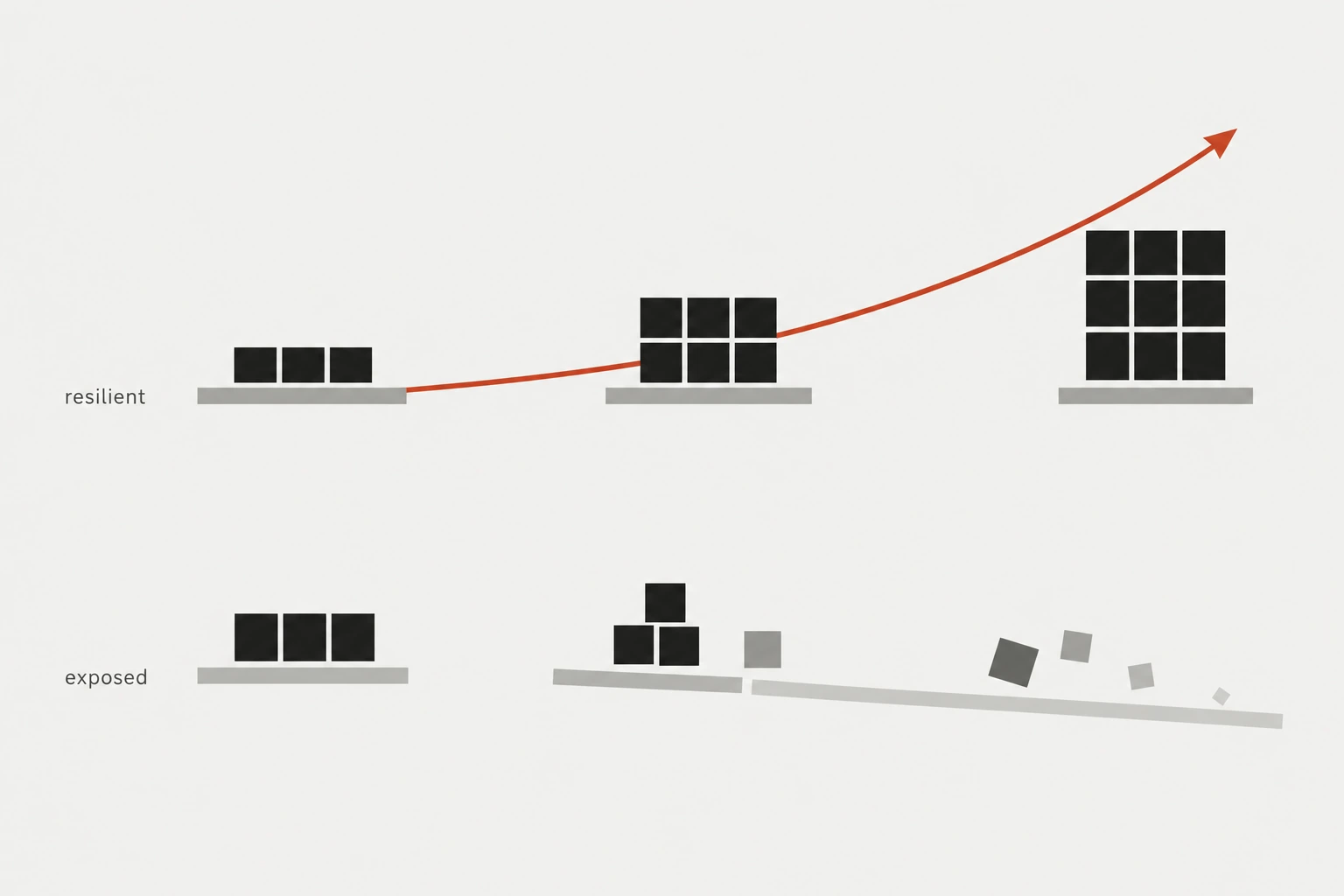
Instead of asking, “How do we force this multi-quarter roadmap to go faster?” the sharper question for an owner-CEO becomes: “Is this commitment velocity-exposed or velocity-resilient?”
- Velocity-Exposed Commitments: Strategic bets whose return depends on technical difficulty remaining high or routine software workflows remaining static. Their value can erode as the work they were designed to solve becomes easier to reproduce.
- Velocity-Resilient Commitments: Strategic bets anchored in core business fundamentals that can gain leverage as external technology accelerates. These commitments are less dependent on technical difficulty remaining high.
Anchoring Capital in Compounding Value
Recognizing the velocity chasm doesn’t mean abandoning long-term strategic ambitions or retreating into endless short-term experiments. High-stakes enterprise growth requires patient capital and organizational commitment.
It means changing how you de-risk a major move.
Assessing a long-term strategy involves more than shortening project timelines or adding approval gates. It includes examining assets—customer trust, unique domain data, physical distribution, and real-world accountability—that may retain or gain value as AI models advance.
Conversely, a commitment that depends on routine knowledge workflows remaining difficult to reproduce can lose value before the work is complete.
The goal for an owner-CEO isn’t to avoid long-term planning. It is to distinguish foundations that may gain value as technology advances from assumptions that could weaken before the work is finished.